


Under the term digital printing we understand a printing technology that allows a printed output to be created without any additional intermediate step. It appeared at the turn of the 1980s and 1990s, and thus belongs among the youngest printing technologies.
The principle of digital printing is simple
The printing content enters the printing machine, which is controlled by its own computer, in digital form. The actual print on the material is created using the principles of electrophotography, inkjet, ionography, magnetography, electrostatic printing and others.
Advantages of digital printing
- quality almost indistinguishable from offset printing,
- price for lower volumes much more advantageous than with offset printing,
- speed of order processing.
Digital vs. offset printing
For small print runs, digital printing replaces offset printing. The efficiency threshold is constantly increasing. At present, it is between 1,000 and 3,000 copies for black and white printing and between 200 and 800 copies for colour printing.
In offset printing, the preparation of the printing materials is significantly more expensive, and the price is the same regardless of the quantity. The larger the print run, the more the preparation costs are distributed into the final price. In the case of digital printing, the preparation consists only of data checking and format setup.
There is also a difference in speed. With digital printing, it is possible to print materials practically on the spot and starting from a single copy. Personalisation is also not a problem, as each printed piece can contain different content.
Digital printing is often used for book printing. Books printed on digital machines, unlike offset printing, do not need to be assembled, which reduces costs and increases production speed. Book production with digital printing – one day; with offset printing – one week. A significant difference, wouldn’t you say?
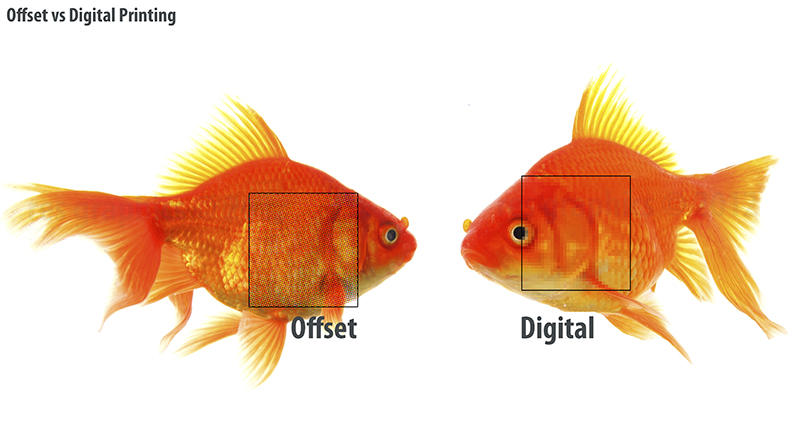
Quality is on the side of offset
The biggest shortcoming of digital printing compared to offset printing is the print quality in the form of graininess or incorrect colour saturation and coverage.
Another disadvantage of digital printing is the high cost for larger quantities. Offset has been, is, and with the greatest probability will continue to be, a much cheaper technology.
Types of digital printers
Today, common on the market are office black-and-white printers, colour printers, production printers, large-format printers, plotters and others. A separate category are printing devices for textile printing based on latex inks.
In Asian countries, mainly in India, China and Korea, textile printing using this technology has spread widely. Printing tables are often made almost by hand, where, for example, T-shirts are attached with pins. Using a pantograph, the print head moves above the T-shirts and prints the same motif. In this way, they can have several dozen printing plates prepared. The result is high efficiency – they can print a large number of T-shirts or other textiles at once.
Because latex inks have now been developed also with white ink, they can print coloured T-shirts in CMYK mode, that is, in full colour.
Printing three-dimensional objects is not a problem
Very interesting are digital printers for printing on three-dimensional objects. They are mainly used in advertising for printing promotional items. The printing ink is UV-based and is cured with UV light.
3D – a novelty you won’t believe until you see it
A special and latest group of digital printers are 3D object printers. They do not print on flat surfaces but in three-dimensional mode. They can be used to create any three-dimensional object. Their use is wide-ranging. They are used in advertising, design, engineering, medicine and many other fields.
Quo vadis, digital printing
Digital printing is a rapidly developing branch of printing. Every year, a new innovation enters the market, always enriching it with new features that traditional printing could not solve. Only the future will show in which direction this field will continue to develop.
Prepared by: Jozef Kákoš, Anatex, s.r.o. – Promotional Products


