Offset printing – one of the youngest printing techniques
Offset printing is one of the youngest printing techniques. It has universal use and is therefore the most widely used in the world. Its name is derived from the English expression off-set – indirect printing, or from the term set-off – transfer.
The parents of offset printing are two gentlemen. Robert Barclay from England developed offset printing on metal in 1875. Several decades later, in 1904, Ira Washington Rubel from the USA managed to apply offset printing to paper.
Description of offset printing
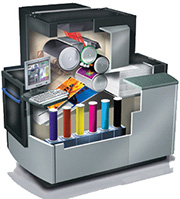
Offset itself is printing from a flat surface, where there is no difference between the printed motif and the non-printed part of the motif. The resulting image is printed from a printing plate, which can be cylindrical or flat, first onto a rubber printing cylinder and only then onto paper. The ink is transferred twice, which is why offset is referred to as indirect printing. Thanks to the rubber surface of the cylinder, it is possible to print even on lower-quality papers with well-rendered details.
Classic wet offset
Classic, wet offset works with the use of water. It uses a printing plate with specific properties, based on the incompatibility of grease and water. The ink used in offset is made on a grease base.
The motif intended for printing is on a printing plate whose surface repels water (is hydrophobic) and thus retains the ink applied by the roller. The non-printing part of the printing plate has, on the contrary, a surface that absorbs water (is hydrophilic) and therefore no ink adheres to it. The printing plate is moistened before ink application by a dampening roller containing water.
Dry, waterless offset
For lower-volume printing, the so-called dry offset has been developed thanks to digital technology. This offset does not work with water dampening. The principle is simple. Using a laser, the printing plate is prepared directly in the machine, having a special surface prepared with silicone. The printed areas are stripped of this silicone surface by laser. Ink does not adhere to the silicone surface of the printing plate, but adheres to the burned-out areas. As with wet offset, printing is transferred to paper using a rubber cylinder.
Dry offset suffers from so-called ink dropouts – white empty spots in the printed output. This problem is caused by small dust particles detaching from the printing plate.
Despite this problem, dry offset achieves high print quality when the technological procedure is followed. The absence of the dampening solution also allows finer screen rulings to be printed.
“Offset” prints with the highest colour accuracy
Offset printing, unlike digital printing, also allows printing with so-called spot colours (PANTONE). Each of these colours has a precise numerical designation and an exact mixing ratio of shades. This advantage predestines it for printing where the output requires the highest colour accuracy.
Lithography – the older brother of offset
The principle of the incompatibility of greasy ink and water has been known for much longer and was only used in an improved form in offset printing. This principle is used in lithography, which was employed in planography, poster production and similar applications.
Offset – printing for the modern age where speed is a priority
Offset printing became dominant in the printing industry in the 1970s, when it replaced letterpress in this position. It is the fastest method of printing in large runs. The speed reaches several tens of thousands of impressions per hour, while letterpress operated far below this limit.
Modernisation and development have advanced offset printing to the point that it is unrivalled in quality and brilliance. Using offset, which reigns in the printing industry, even plastic materials and metal sheets are printed today, mostly used in the packaging industry.
The disadvantage of offset is the fact that it is not suitable for low-volume printing. However, this shortcoming has been filled by digital printing, which dominates advertising and has the advantage of being able to print even a single copy in quality comparable to offset.
Prepared by: Jozef Kákoš, Anatex, s.r.o. – Promotional Products