The industrial revolution in the 18th century and the related rise of a consumer lifestyle led to an increased demand for pocket and wristwatches. The new working class desired goods that had previously been accessible only to the upper classes. Watchmaking companies in Switzerland recognised this trend and began producing pocket watches on a mass scale for anonymous customers.
From manual production, most family businesses transformed into machine production. The biggest problem was the finishing of the watches – specifically, the production of the dials. When manufacturing to order, the dial was the work of an engraver. However, in mass production, this was not feasible, and screen printing was not suitable either, because the dials were often not flat and the font size was so small that it exceeded its capabilities.
The principle of pad printing
The first attempts at pad printing date back to the 18th century. The very principle of this technique is based on intaglio printing, or printing from depth. This means that the printed motif was engraved by the engraver onto a flat metal plate. Ink was applied to the plate, then wiped off, leaving ink only in the engraved recesses.
The problem then was how to transfer this ink to another object – in the case of watches, to the dial. The first experiments were carried out using pads made from natural gelatin, known as agar. This was obtained from seaweed and animal gelatin – a jelly-like substance. By thickening this material, sufficient firmness of the pad was achieved. The perfectly smooth yet flexible surface of the gelatin, when pressed onto the printing form, picked up the ink from the engraving and transferred it onto its surface. The pad was then simply pressed onto the dial.
The principle on which this works is based on the fact that the surface of the gelatin pad has low surface tension and can therefore transfer the ink almost completely to the printed object. The disadvantage was the short lifespan of such pads – they could produce around 20 prints. However, for the beginning of production, this was sufficient and, above all, incomparably faster and cheaper than engraving.
The principle remained, the technology advanced
Modern pad printing machines work on the same principle, but the entire technology has been perfected since then. Pads are now made from silicone rubber and have a long service life. Printing forms, today commonly called clichés (the Slovak term štočok is also used), are made from various materials. The choice of material depends on the type of production or the number of impressions the plate must withstand. For mass production, steel clichés are used, with a lifespan of several hundred thousand or even millions of impressions. For small print runs, photopolymer clichés are most commonly used today. They offer an interesting balance between cost and durability, typically lasting several tens of thousands of impressions.
Clichés are produced using a photochemical process. A light-sensitive layer is exposed through a film containing the printing motif. The plate is then washed in a developing solution. The unexposed parts of the motif are washed away, forming recesses in the plate where the ink will be held.
Pad printing machines have also evolved. Manual pad printers are produced for very small runs, as well as one- to multi-colour machines capable of full-colour (CMYK) printing.
Advantages of pad printing
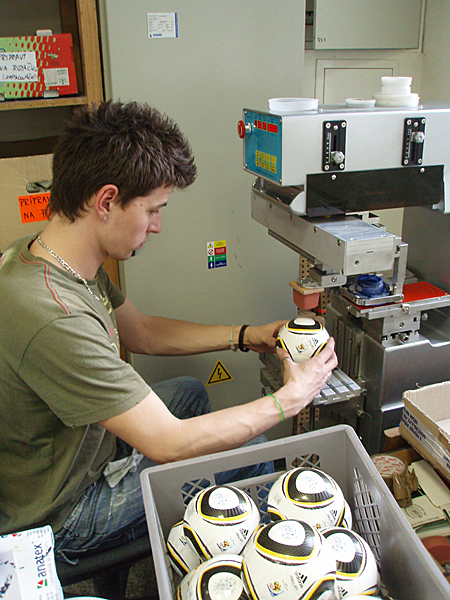
The main advantage of this technology is its ability to print on non-flat and three-dimensional objects. The flexible, compressible pad easily adapts to the shape of the object being printed. Solvent-based, one- or two-component, UV inks and varnishes are used. The quality of these inks is so high that they can even be used in the toy and food industries.
The application of pad printing is extensive – it is used in almost all manufacturing sectors where there is a need to print on non-flat objects. It is also widely used in the advertising industry for printing on a variety of promotional items to enhance their aesthetic or functional value.
Pad printing is economically efficient and, importantly, also fast. In automatic operation, it can reach speeds of up to 1,600 impressions per hour, a level that its biggest competitor – digital printing – has not yet achieved. And even though it is not taught comprehensively at any printing school, we see its future very optimistically.
Prepared by: Jozef Kákoš, Anatex, s.r.o. – Promotional Products