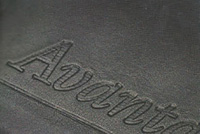
You have certainly held in your hands an object marked with embossing. It looked elegant, felt pleasant to the touch, and if it was a document, it gave it a sense of importance. Embossing belongs among the oldest technologies, and we are happy to share a few interesting facts with you.
A bit of history
The predecessors of embossing – or blind printing – can be considered the seal cylinders of the ancient Sumerians from the period 2500 to 3000 years before our era. They served as a signature of authenticity for important documents on clay tablets, some of which have survived to this day. Later, other stamps made of copper, bronze or steel were used to decorate various objects, whether ceramics, jewellery, or leather goods.
With the production of books, embossing spread even further. Books were written or copied by hand, and thanks to embossing, very valuable bindings were created, increasing their artistic value. In the 15th century, Johannes Gutenberg invented letterpress printing – a field that began to develop on a mass scale. The price of books dropped dramatically, making them available to a wider public.
The principle of embossing remains unchanged today
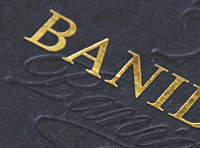
Using pressure and heat, a printing die transfers the printed motif through a stamping foil onto leather, imitation leather, plastics or paper. Stamping foils are produced in gold or silver variants. They consist of a vaporised metal layer on a separating layer applied to a plastic carrier film. Today, various colour shades of stamping foils are available on the market.
Dies are made of brass by engraving or milling. They are the highest quality and are intended for large print runs or frequently repeated embossing. More affordable dies are made of magnesium using photochemical processes and etching. For softer materials, dies with a high relief (leather, imitation leather) are more suitable, and for hard materials, those with a lower relief.
If the stamping foil is omitted in embossing, we speak of blind printing. This is a relief print that enhances the printed product or other materials. In printing, relief embossing using a matrix and counter-matrix is widely used. The resulting embossing is raised outward in relief and is used to highlight already printed graphics. This type of printing is applied in the production of postcards, greeting cards, valuable printed materials, business cards and similar products.
Where you can encounter embossing
Today, embossing is used to protect products by means of stamping marks, guaranteeing their authenticity. It is also indispensable in the banking industry. It is an important security feature against counterfeiting. If the stamping foil carries a holographic record, it becomes an insurmountable barrier for counterfeiters. The protection lies, for example, in the fact that the holographic record carries a specific DNA sequence, though it is not revealed what type of DNA it is. In the vast animal and plant world, this remains an undetectable protective element. With this very old printing technology, we can ensure the authenticity of a product.
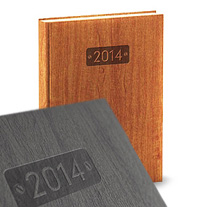
In advertising, the technology of embossing, blind printing or relief printing is used for embossing diaries, calendars, business cards, stickers, letterheads and similar representative printed materials.
From manual to mechanised embossing machines
From originally manual embossing, devices and machines for mechanised embossing have been developed. For small print runs, manual machines with a heated stamping head are widely used. For large-scale embossing, machines capable of operating in automatic mode are produced. In printing houses, letterpress machines are used, but they must be equipped with embossing accessories.
To a small extent, embossing competes with digital laser cutting. This technology allows for the removal of parts of printed material by cutting – something embossing cannot achieve. It is used, for example, to create windows or ornamental shapes. We can consider it a new technology that enhances the value of printed materials.
Prepared by: Jozef Kákoš