


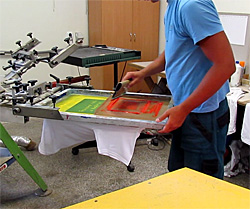
Screen printing, in its basic form as we know it today, originated in China around the 10th century BC. It is the oldest printing technology, apart from the primitive technique of pressing any coloured object onto another surface. Its emergence was largely due to the technological development of the country and the demand for decorative designs on various textiles, including silk.
It wouldn’t have been possible without mastering silk production
The very principle of screen printing depends on a fine, high-quality, densely woven fabric. Silk met these criteria. The printing matrix was a simple wooden frame with silk stretched over it. Using natural resins or wax, craftsmen manually created the design for printing on the frame. The principle is that the areas of the fabric that are to be printed remain open, while the areas not to be printed are masked (covered) with resin or wax.
In this way, ancient masters prepared printing patterns that could be reused many times with unchanged quality. The printer applied ink to the frame and, using a wooden squeegee, transferred the design onto the desired object. The frame was placed on the object to be printed, and the colour was pressed through the design with the squeegee. The masked parts of the frame blocked the ink, while the unmasked parts allowed the colour to pass through onto the object—most often another textile for further use, or paper, or leather.
The ancient masters even mastered multicolour printing
Naturally, a separate frame had to be made for each colour. This allowed them to produce a large number of prints much faster and to reproduce them whenever needed. The process, however, depended on the durability of the printing frames. Another chapter was the creation and use of inks. Colours were made from mineral pigments or pigments from plants and animals. As binders, natural resins and starches were used.
Europe had to wait for screen printing
This printing technique reached the rest of the world relatively late. Some sources claim that it arrived in Europe around the 18th century, and somewhat earlier in the Arab world, where screen printing was already used in wallpaper production in the 14th century. In my opinion, thanks to trade with the Orient, screen printing may have reached Europe earlier. Evidence of this can be seen in fabric wallpapers preserved in many historical buildings.
By the 18th century, certain guilds in Europe had already mastered the production of wallpapers using the flock technique. This was a highly decorative surface treatment that was rare and valuable at the time. The desired pattern was first applied to the fabric with adhesive, which itself was printed through a screen. Onto the still-wet adhesive, coloured textile fibres were blown manually. The pattern on the wallpaper became visible once the fibres adhered to the glue.
You won’t learn screen printing at school
If you wanted to study screen printing, you would have to travel to China or India. In Europe or the USA, such educational institutions do not exist. Here, this craft is passed down from person to person, allowing generations of printers to discover this fascinating printing technique. The most renowned expert in Europe is the Frenchman Michel Caza. Thanks to his contribution, screen printing is experiencing a renaissance and has become one of the modern technologies used in industrial and artistic printing, textile production and advertising.
The principle remains, but the materials have changed
Today’s screen printing is based on the same principle but uses modern materials. Frames are made of metal; fabrics vary depending on use, including metal meshes for high-volume printing. Masking is now done using light-sensitive materials and films. The biggest advances have come in inks. All are high-quality solvent- or water-based, or plastisol inks cured by heat. We must not forget UV inks, which are cured by ultraviolet light.
The future looks bright
The era of digital printing has not pushed screen printing out of the market, mainly because of its low cost. Worldwide, there are many manufacturers of materials, equipment and accessories. Devices for manual printing, semi-automatic and fully automatic machines for large-volume printing are produced. Ink manufacturers compete in quality and variety, and the same applies to other necessary materials. We can therefore confidently say that screen printing has not yet said its last word, and future generations can continue to develop this time-tested technology.


